Blog Clone

Unlock the True Superpower of Functional Fitness: Stimulating Behavior

Most people train to change how they look; we train to change how you operate.

Exercise is widely recognized for building muscle, losing fat, boosting health, and helping you generally feel better. But there is a much more powerful, often overlooked benefit: the ability to stimulate specific behaviors for the rest of your day. Think of exercise not just as a physical task, but as a way of “changing the settings” of your general being.

Priming your brain for different outcomes

By choosing specific types of movement, you can prime your brain for different outcomes:

  • Explosive Training: High-intensity, powerful movements lead to more assertive and confident behavior in your professional and personal life.
  • Movement Skill Training: Complex coordination tasks and skill-based work lead to greater creativity and cognitive flexibility.
  • Slow Movement & Contrast Therapy: Incorporating breathwork and temperature shifts (like ice baths or saunas) promotes deeper healing and nervous system regulation.

Exercise and the Nervous System

Your central nervous system has one primary function: to predict what is going to happen next. To make these predictions, it constantly gathers data from three main areas:

  • The Internal Body: Monitoring blood sugar, muscle tension, and heart rate.
  • The External Environment: Processing light, sound, and even smells.
  • Stored Patterns: Drawing on your established routines and deeply held beliefs.
If your body is stiff, your mind is stiff. Functional fitness resets the signals so your brain predicts safety and success instead.

How Exercise Stimulates Behavior

Beyond obvious effects like metabolism spikes and stress release, subtle changes in your fascia, breathing patterns, posture, core temperature, and muscle tone are vital. Every support system in your body sends a constant stream of information to the brain, acting as a steering wheel for your nervous system and your outward behavior.

What “Settings” Can You Change?

Depending on how you train, you can manually adjust your internal settings for:

  • Recovery and Sleep: Using down-regulating movements to signal safety to the brain.
  • Focus and Creativity: Engaging the senses to sharpen mental clarity.
  • Sociability and Assertiveness: Building physiological confidence for high-pressure environments.
  • Sexual Desire: Improving blood flow and hormonal balance through targeted movement.

The Levers of Control

To achieve these states, you adjust the specific variables of your session:

  • Physical Levers: Breathing techniques, rep ranges, and total load used.
  • Environmental Levers: Your light environment and even the clothing you wear.
  • Mental & Social Levers: Your intention, food and drink intake, and social connection.

Want to experience this for yourself?

Stop exercising at random and start training with purpose. Instead of having to figure out all the tiny intricate details for yourself, make use of the 20,000+ hours I’ve spent looking into health and fitness. Join our classes and let me show you how that expertise translates directly to your body and mind.

Finishing up

Join our classes for free for the first seven days and make up your mind afterwards—no strings attached.

Further Reading & Resources

Internal Guides

External SEO Resources

Movement Training: How Your Body Shapes the Way You Think and Communicate

Communication is important, right? I’m sure you’ve had instances where you’ve messed up by saying the wrong thing.

But communication consists of more than just words. Communication is also tone of voice, posture, eyes, facial contractions and your general vibe.

Movement training as a way of articulating yourself

As a species we’re more sedentary than ever. Locked-up hips, shoulders rolling forward and protruding necks are very common.

And when we do decide to move, it’s often very rigid with lots of unnecessary tension.

I want you to ask yourself: what will this do to your ability to express yourself and to communicate?

The body & mind connection

Everything affects everything all the time. That is to me how reality works — feedback loops.

If your body is stiff, your mind is stiff.
If your mind is stiff, life gets very hard.

But what if you’re relaxed and in tune with your body?

If your body is stiff, your mind is stiff. If your mind is stiff, life gets very hard.

Training and expression

When we think of training, push-ups, squats, running and perhaps pilates come to mind. These are not bad per se, but they’re all focussed on muscles, on results.

What if we relay the focus? What if we focus on movement, breathing, on presence and on expressing yourself — to become more human?

Curious to explore this further?

Movement, breath, and awareness are all trainable. If you want to experience this in a structured way, come try a class and feel the difference for yourself.

Makes sense, so what’s next?

Let me give you a few things you can tinker with:

  • Animal flow — explore natural movement patterns
  • Coiling — moving a hammer, mace or club Rhythmical running
  • Rhythmical running — skipping, hopping & running drills
  • Movement skill training: throwing, jumping, climbing, crawling etc.

Finishing up

Try not to chase anything. Just relax, enjoy the movement, being in touch with your body and learn to articulate through non verbal communication rather than words.

Internal Links

External Links

How I deal with aggression during my kids fitness class

Aggression mixed with kids sounds like a terrible mix, right? A few years ago I would’ve agreed. Through experience I’ve learned that kids test and use aggression. They test strength. They push boundaries to see what holds.

Boys often do it physically — kicking, slapping, wrestling energy. Girls often do it socially — ignoring, teasing, challenging authority. Different expression. Same underlying instinct. They’re exploring hierarchy and boundaries.

My response? With girls — direct eye contact, calm confrontation, exposing the behaviour clearly and directly. With boys —controlled physical redirection, firm body language, and strong presence.

With both — appropriate physical contact (a steady hand on the shoulder, a guiding touch on the back) that communicates: I’m here. I’m not rattled.

Through experience I’ve learned that kids test aggression. They test strength. They push boundaries to see what holds.

The current predicament

Many men have been taught to prioritise softness above all else. Empathy is important. But without firmness, it collapses.

Kids need boundaries. They need leadership. They need someone in the room who can handle their chaos without flinching. If there’s no wall, they keep pushing. And if there’s no wall at all, they meet the world unprepared.

My own experience

When I first started running kids fitness classes, I was too soft. Too accommodating. Too reactive to tears. Too easily drawn into their games.

Result? They ran the room. Doesn’t work.

My approach now

I’m firm. Clear. Calm. Harsh when necessary — but always steady. The smile only disappears when someone is at risk or when a real boundary is crossed.

I use:

  • direct eye contact
  • tone shifts
  • time-outs
  • push-ups
  • immediate consequences
  • physical redirection when needed

But the lesson must be understood. Discipline without comprehension is just noise.

What I see

Working with kids, you can often see when something at home is unstable. Lack of boundaries.
Inconsistent authority. Emotional distance.
Running a family is hard, so I don’t judge. I just try to provide stability when they’re in my room. It takes a village.

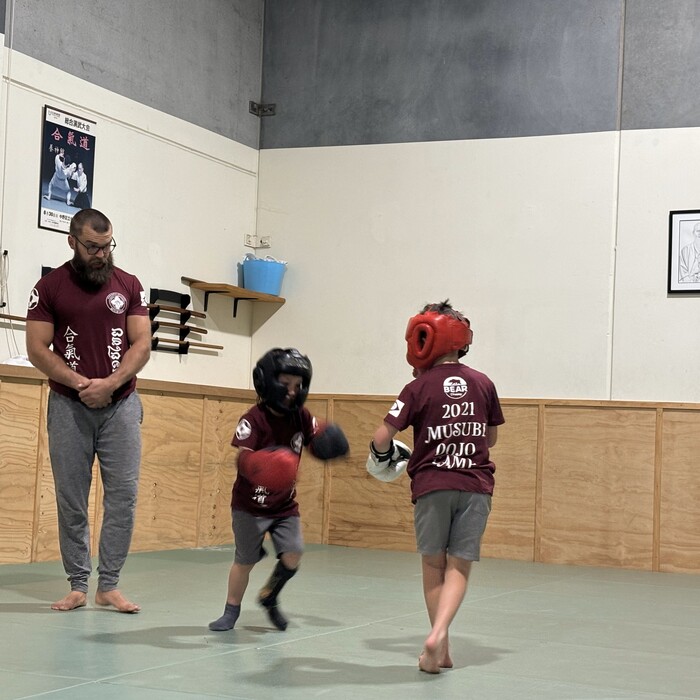
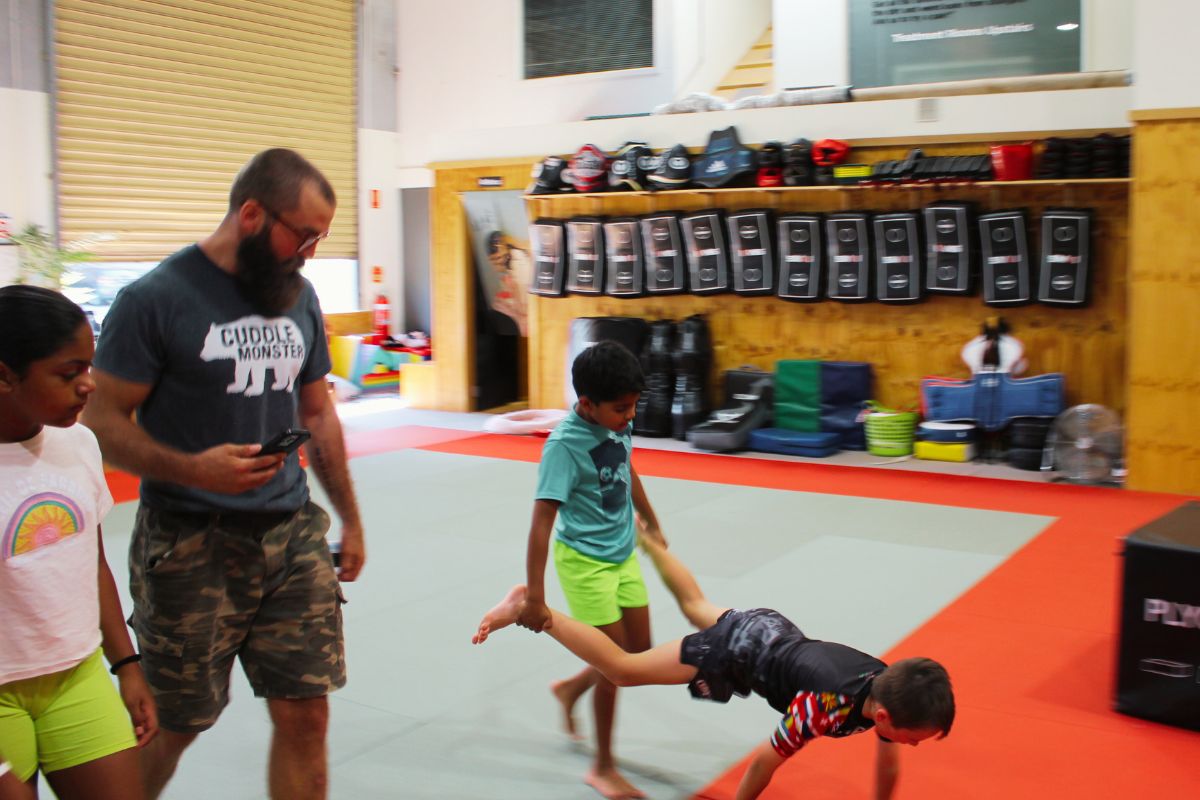
Instructor Willem supervising kids during a martial arts sparring session at Eltham Martial Arts Academy

A fun little detail

In my class, I lead. When I say no, it’s no. But I also let them challenge me.

If I forget a child’s name three times, they can make me do push-ups in front of the whole class. If they land a genuinely clever joke, I allow it. Because this isn’t about ego. It’s about showing them what confident authority looks likemore importantly, this way I show it’s not about me, it’s about them.

Need a hand?

Confrontation is my specialty. Are your kids running amuck? Do you need someone to backup your parenting style. Do you want your kids fit and strong? Send them over

The takeaway

Life contains conflict. Kids need exposure to controlled intensity in a safe environment.

Be firm.
Be steady.
Be unshaken.

They don’t need endless softness. They need strength they can trust.

Internal Links

External Links

What does functional training actually mean?

The word functional gets thrown around a lot. It’s almost a misnomer, because technically every intentional movement is functional. Every exercise stimulates the body and, when done right, improves strength and conditioning.

But Functional Fitness—what we focus on at Functional Fitness Eltham—goes deeper. It’s not just about aesthetics, it’s about application. It’s training for life.

General fitness tends to aim for losing fat, building muscle, or improving conditioning. That’s fine. But functional training looks at the human first—the demands of real life, the stress of parenting, work, travel, sport, or even just getting older. Strength, mobility, coordination, and balance become tools for living well, not for looking good in a mirror.

Functional training looks at the human first—the demands of real life, the stress of parenting, work, travel, sport, or even just getting older.

The Philosophy Behind How We Train

Our sessions are built for people who want to live fully—to have the strength to carry kids, lift luggage, climb, hike, and move without pain.
You don’t need to chase metrics or personal records. Instead, we focus on movement quality, body awareness, and experience. We train to become better humans—mentally, emotionally, and physically—not to impress social media.

So what does that look like?
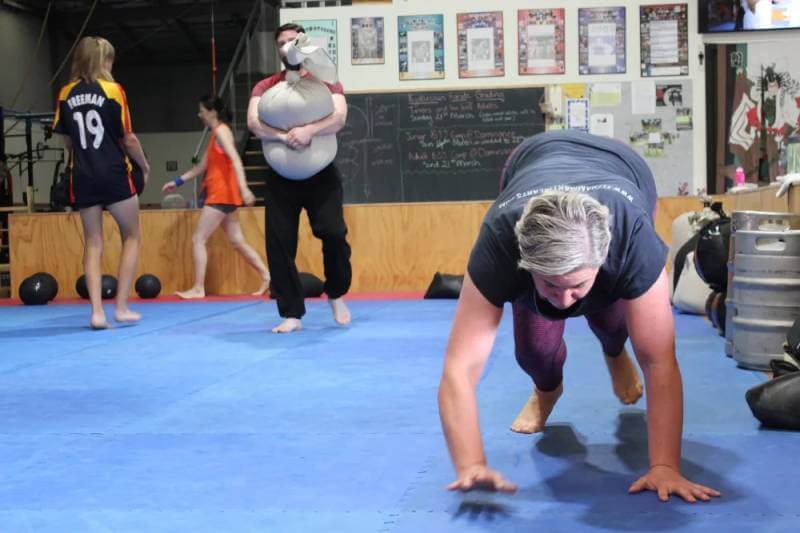
Think lifting awkward objects, carrying heavy bags, pushing sleds, or crawling on the ground. Think less about how many kilos you’re lifting and more about how your body moves. Less “beach muscles,” more “real-world resilience.”

We don’t just count reps—we pay attention to how those reps feel.
Our aim? To help you reconnect with your body and rediscover movement as something joyful, not transactional.

social group fitness eltham melbourne

Why You Shouldn’t Join Us

If your goal is to get as jacked as possible, post mirror selfies, or chase numbers just to prove something—you might not fit here.
If you care more about competition than connection, or if ticking the “I’ve trained today” box is all that matters, we’re probably not your tribe.

We’re not here to sculpt statues.
We’re here to help people live better—in their bodies, in their relationships, in their day-to-day life.

Give us a try for free

Living a busy life? Not able to stick to a fitness routine–let us help. Just rock-up, and let us take care of the rest.

Who Is a Good Fit

You want to be a better parent, partner, or human.
You want to travel when you’re older, and still have the energy to live freely.
Maybe you deal with stress, anxiety, or that sense that life is just… heavy sometimes.
If that’s the case—then Functional Fitness Eltham is exactly where you belong.

We train to move, to connect, to grow.
And if that resonates with you, we’ll see you soon.

Further Reading: Functional Fitness

Internal Links

External Links

What I’ve Learned from Running Neurodivergent Kids’ Fitness Classes So Far

Our NDIS-funded neurodivergent kids’ fitness class has been running for about a year now. I used to coach alongside others when the session was hosted by Move Play Grow Physiotherapy, where I just acted as a coach and drew a regular wage. Now that the physiotherapy place has its own gym, we’ve parted ways—and these days, I run the class on my own.

Before I go into my experience with the class, I’ll share a few details about myself, so you know where I’m coming from. I personally have a strong case of ADHD and have taken medication for over 10 years. The long-term effects of taking ADHD medication have had an incredibly negative impact on my life. Beyond a complete detachment from my emotions, I felt like I was weird and different.

I felt like I was weird and different. I wanted to save the kids from what I went through, and instead, try and embrace their differences.

Now, back to the experience of the class. I obviously want to save the kids from what I went through, and instead, try and embrace their differences. When the class was headed by the other place, the coach I was instructing with wanted to notify me of all the disabilities the kids had, and I actually didn’t want a bar of it. My aim was simple: forget their label and focus on core values that go beyond ability, age, gender, and background—the willingness to push yourself, humility, and working together. Abilities that, if taught right, will stick for a lifetime. That was my goal.

Please don’t think that the process went smoothly, as many mistakes were made. Yeah, some games just did not work, some exercises did not work, and every so often I just lost kids. We adults tend to forget that not everyone thinks like us, and once you get frustrated—oh boy… But you know what, I can honestly say that my heart was in the right place, and the kids could sense it.

One of the things that the kids taught me is that you can only plan so much. It’s best to stay in the present, have a broad idea of what you want to do, and adjust in the moment. The reason why this is so true is because kids are masters at reading people, and if you get frustrated, if you get upset, or if you just don’t want to be there, then you cannot hold space, and can therefore not truly reach the kids and instill important lessons. No, instead just try and create one moment where the kids overcome themselves—either through fear, failure, loss, and so forth.

Now that we’re on the topic, I’ll share another insight I got from working with kids: kids are oblivious to dogma. If something doesn’t feel right, children either don’t want to do it or do a horrible job. We adults tend to think we’re so superior, but we can learn from kids in this way. How did I learn this? When I came to Australia, I had a sport science degree under my belt, as well as a few years of coaching and personal training experience. I also had about 14 years of fitness experience, but the kids taught me something—they taught me that many of the exercises I did on a regular basis didn’t make a lot of sense.

Let’s zoom out before we continue. I’ve always been eccentric with my training. Yes, I’ve done CrossFit, used to run marathons, did plenty of barbell and machine work, but I always looked to rediscover the wheel, finding different ways to exercise and challenge the status quo. But it was only after I started coaching kids that functional fitness had any meaning at all.

Give a kid a barbell to lift, get them to do a pushup or a bodyweight squat, and not only will they risk hurting themselves because of a lack of body awareness—their technique is horrible. But get them to jump on a box, lift a ball, or push something away, and lo and behold: perfect technique!

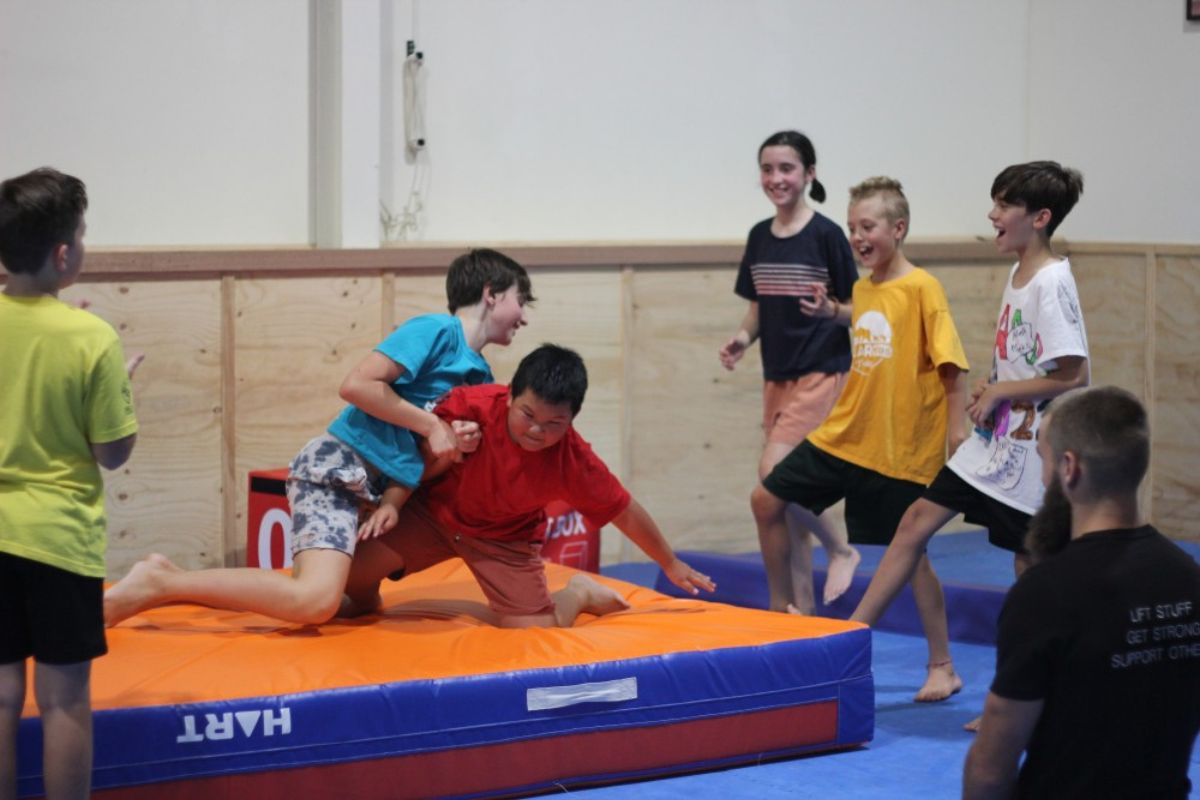
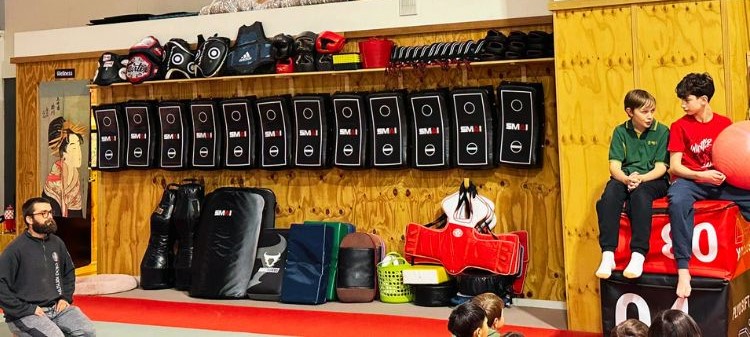
Two teenage boys assisting as mentors during an NDIS-funded neurodivergent kids fitness class at Functional Fitness Eltham, supporting younger participants.

If you think about it, it makes perfect sense. We as a species have a blueprint for human movement. We’ve moved a certain way for thousands of years. It’s only been less than a hundred years (50 even) that we’ve created this aberrant way of moving (e.g., barbell squat, chest press). Now, I can talk about this topic for hours, but maybe another time—back to the neurodivergent kids’ fitness class.

So yeah, focus on the kids, get them to overcome obstacles, and let the exercises make sense—cool. Another thing I want to mention is how these kids taught me the value of games—something else we adults tend to forget. Not only do games help you learn much faster (yes, there’s research on this), but they also help you relax and maintain a playful attitude throughout life. You should see grown men play games together: they start out super awkward but end up giggling and opening up—super fun to watch.

I’ll finish up with our most recent addition to the class, something that’ll give you warm and fuzzy feelings: neurodivergent teenage boys coaching the kids. I see quite a few kids on a regular basis and always try to get them to take the next step (emphasis on ‘them’ taking the next step). And two boys in particular have gained my trust over time. Interestingly enough, the two of them are like Yin and Yang—one tends to keep to himself and observe, and the other is super social and constantly looks to engage. I must also mention the second teenager has a speech impediment (important to remember).

So last week, the 23rd of July, we kicked off our first NDIS-funded neurodivergent fitness class with the two boys helping out, and WOW! Everyone that was present, and especially the social worker of one of the boys and the mum of the other boy, were just taken aback by how well they did. Not only did they feed off of one another, they were patient, excited, and had pretty decent ideas. Also, the boy with the speech impediment barely stuttered.

Learn more about the neurodivergent kids fitness program

Want to know how we’ve catered to neurodivergent kids?. Head over to our dedicated webpage to find out how this class differs from the other kids classes.

Now remember how I talked about dogma? If you forget what’s ‘normal’ for a moment, think about the effect of giving teenage boys trust and responsibility over younger kids, as well as a small monetary incentive. You have a winning combination—it’s how we’re designed to function, as a true community.

I cannot put into words how excited I am about the future of this class. It’s almost as if the universe has called me to run these classes, and remind us of our humanity. It sounds cliché, until you see it for yourself—then you’ll understand. I sadly don’t have kids of my own (except for three step kids that hate me most of the time), because my partner is a fair bit older than I am, so this is my way to feel a bit like a dad. To try and be a role model to the future generation, and do my part in preparing our kids for the ‘interesting’ future that’s ahead of us.

Further Reading: Neurodivergent Kids, Fitness, and Inclusion